
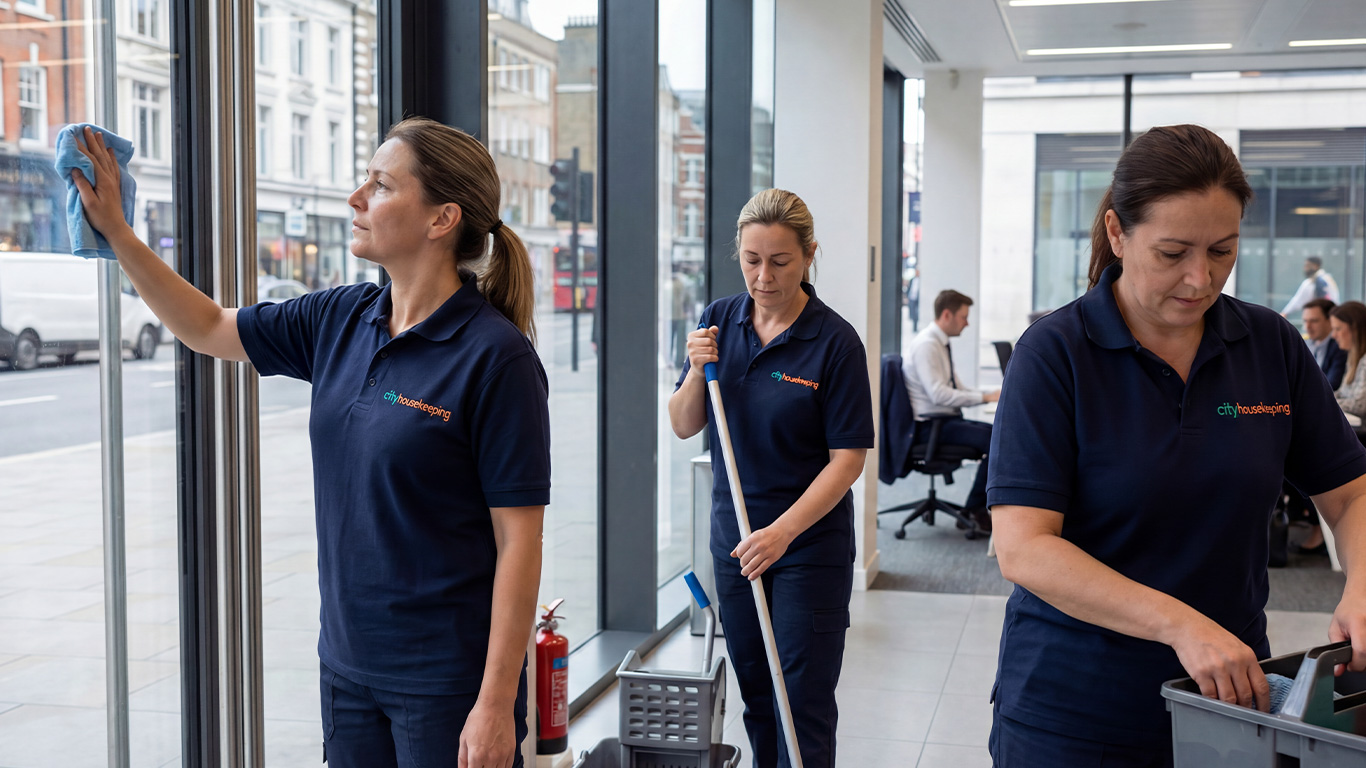
You probably want one of two results when looking for business cleaning services in London:
- a clearly cleaner, consistently client-ready workspace, and
- a clean, healthy workplace that satisfies contemporary standards for cleanliness and promotes employee well-being.
The city of London is competitive. Your brand experience includes cleanliness, regardless of whether you oversee an office, store, studio, gym, clinic, or shared workspace. Properly executed, business cleaning is imperceptible, yet it enhances efficiency, safeguards resources, and subtly conveys professionalism to all visitors.
This article discusses the normal service schedules, what commercial cleaning should entail, how London firms can assess providers, and why businesses like CityHousekeeping base their cleaning operations on consistency, dependability, and customised scopes.
What “London Commercial Cleaning Services” Actually Means
Everyday, weekly, or sporadic deep cleanings are examples of commercial cleaning, which is planned, repeatable, and accountable cleaning performed to a specified standard. Unlike household cleaning, it requires consideration of:
- rapid re-soiling and increased foot traffic
- common touchpoints (kitchens, restrooms, door knobs)
- standards for compliance (particularly for facilities that are linked to food, healthcare, and the general public)
- overtime (weekends, evenings, and early mornings)
- continuity of service (holiday coverage, dependable personnel, regular checklists)
With cleaning services available on a daily, weekly, or as-needed basis, CityHousekeeping bases its commercial and office cleaning on maintaining “professional and welcoming” workplaces.
The Reasons Behind London Companies’ Commercial Cleaning Outsourcing
When cleaning results are inconsistent or staff time is diverted, many firms attempt to address cleaning internally first before turning to specialists. It usually makes sense to outsource since qualified vendors offer:
- industrial-grade machinery and procedures (not home-use instruments)
- trained housekeepers who follow a checklist and
- Consistent quality and reliable schedule
- improved results in terms of hygiene, particularly in kitchens and restrooms
- Saving time for your managers and employees
These advantages are highlighted in CityHousekeeping’s commercial cleaning guidelines: enhanced workplace hygiene, industrial-grade equipment, and cutting-edge techniques—all of which are crucial given the modern standards for sanitisation and welfare.
The Components of Commercial Cleaning Services
Although the scope will be customised for your location by a quality provider, the majority of London commercial cleaning contracts contain some mix of the following:
Regular (Contract) or Daily Cleaning
- Mopping floors and/or vacuuming (including edges when possible)
- Dusting shelves, ledges, desks (policy-dependent), and other surfaces that are visible
- Cleaning the conference rooms and common spaces
- Bins should be emptied and liners replaced.
- Cleaning the countertops, sinks, and appliance fronts in the kitchen and break room
- Cleaning of restrooms, including sinks, mirrors, touchpoints, and toilets
- replenishing consumables, if any are included
Common business cleaning services include waste removal, social areas, lavatory upkeep, daily office cleaning and kitchens and break rooms are listed by CityHousekeeping.
Frequent Deep Cleaning
- Carefully cleaning the grout and descaling the bathroom
- High-level dusting (when available and safe)
- thorough degreasing of the kitchen (backsplashes, cabinet fronts, and appliance exteriors)
- Floor refresh (specific treatment depending on the type of floor, such as polishing, scrubber, or
- Spot cleaning of walls in high-contact regions
The service ecosystem offered by CityHousekeeping comprises deep cleaning and specialised solutions that, based on your industry and foot traffic, can be added to standard contracts.
Expert Add-Ons (Very Popular in London)
- Cleaning of upholstery and carpets
- Cleaning and disinfection
- Cleaning windows
- Fabric surfaces can be steam cleaned for hygienic reasons.
Offices with soft seating or client-facing areas may benefit from CityHousekeeping’s eco-friendly steam cleaning of carpets, couches, and upholstery utilising high-temperature filtered water.
Effective Schedules for Commercial Cleaning
There is only one “optimal” timetable, and that is the one that fits your industry, risk profile, and foot traffic. A logical place to start:
Typical corporate/professional services offices
- Baths, kitchens, floors, and dumpsters two to five times a week
- Deep cleaning of kitchens and restrooms once a month
- quarterly upholstery and carpet cleaning when necessary
Clinics, studios, fitness centers, and popular websites
- Cleaning every day (or occasionally several daily touchpoint cleanings)
- Deep cleanings and scheduled disinfecting according to usage
Retail and hospitality-related settings
- Daily floor, glass, and entryway cleaning for customers
- Regular maintenance of restrooms
- Ability to respond to stains and spots
The flexible schedules (daily, weekly, or as needed) that CityHousekeeping’s office cleaning service is specifically built around are crucial for London businesses with shifting access requirements and hours.
Tips for Selecting London’s Top Commercial Cleaning Company
Businesses may see comparable Google results when they search for commercial cleaning services in London. The operating model of the service is the true distinction. Utilise this checklist:
1) Clear checklists and scope
A detailed description of what is cleaned, how frequently, and to what standard should be given to you. Consistent audits are supported and “it’s been done” arguments are avoided.
2) Operational flexibility
A competent provider avoids:
- opening times
- presence of employees
- procedures for security
- building access (alarms, keyholding, concierge)
Office cleaning that fits your schedule is what CityHousekeeping offers, which is essential for London locations.
3) Professionalism and insurance indications
Clients in the business sector should anticipate professional behaviour and suitable insurance coverage. Sometimes, these trust indicators (such background checks and public liability insurance) can be found in third-party listings.
4) The ability to provide specialised assistance
You may simplify your vendor relationship and maintain uniform standards for all services if your supplier can also take care of deep cleaning, upholstery, carpets, windows, and steam cleaning on a regular basis. A business plan can benefit from a number of services listed by CityHousekeeping, including steam cleaning, windows, office/commercial, and more.
5) Evidence: testimonials, expertise, and performance history
Find reliable indicators, such as evaluations, case studies, or statements that demonstrate scale (e.g., number of offices cleaned). Cleaning a lot of offices and becoming insured are mentioned on CityHousekeeping’s office cleaning site.
Expectations for the First Week of Onboarding (Done Correctly)
A competent commercial cleaner will approach onboarding as if it were a small project:
- Risk assessment and site inspection
- Consensus on frequencies, scope, and any exclusions
- Determination of “priority zones” (reception, kitchens, and amenities)
- Verification of the policy for suppliers and consumables
- Establish an issue escalation process (who to contact, response times).
- First-week quality check to verify requirements and modify schedule
When criteria are established at onboarding, CityHousekeeping places a strong emphasis on customised commercial cleaning and dependability.
Key Outcomes: Hygiene, Productivity, and Brand
There is more to commercial cleaning than “clean floors.” When used correctly, it supports:
- Image of the brand: meeting spaces, restrooms, and reception areas convey professionalism
- Reduced danger of dust, allergies, and cross-contamination for employee well-being
- Productivity: neat, orderly spaces minimise conflict and interruptions.
- Client trust: particularly in fields that deal with patients, wellness, and healthcare
The commercial cleaning content from CityHousekeeping makes a clear connection between cleanliness and the results that matter to decision-makers: productivity, well-being, and brand perception.
FAQs: London Commercial Cleaning Services
How much does it cost to clean a business in London?
The cost is determined by the number of restrooms, foot traffic, square footage, frequency, and specialised requirements (disinfection, carpets, and windows). Pricing isn’t like-for-like until scopes and frequencies are aligned across bids, which is the most trustworthy method of comparison.
How does office cleaning differ from commercial cleaning?
Commercial cleaning includes office cleaning as a subset. Additionally, retail stores, gyms, studios, clinics, and other commercial spaces can be cleaned by commercial cleaning services. CityHousekeeping provides general commercial cleaning services as well as office cleaning.
Does a commercial cleaner have their own materials with them?
Some use client-provided consumables (towels, soap, toilet paper), while others use all supplies. Be sure of this before you begin.
Can we include recurring deep cleanings?
Yes, a lot of firms in London have scheduled deep cleanings in addition to maintenance contracts. Deep cleaning and speciality cleaning alternatives are listed by CityHousekeeping as ways to enhance a routine cleaning schedule.
Final Thoughts: London Businesses’ “Easy Win” Strategy
The best course of action if maintaining a tidy, businesslike workspace is your aim is:
- Set up floors, bins, kitchens, and restrooms according to a dependable schedule.
- Include routine deep cleaning in the kitchen and bathrooms.
- Add carpet/upholstery/steam cleaning as necessary.
- Monthly audit results should be adjusted, and scope should not be allowed to slip.
For London businesses seeking a single supplier and reliable results, CityHousekeeping’s service model—office and commercial cleaning with the option of deep and steam cleaning—fits that model nicely.


