

Move out cleaning in London looks a bit different this year. Since 1 May 2026, the Renters’ Rights Act has changed how tenancies in England start and end. Fixed-term contracts no longer exist and notice periods work differently. A lot of London tenants we speak to aren’t sure what that means for end of tenancy cleaning, or for getting their deposit back.
Some things changed. Some didn’t. Here’s what matters if you’re planning to move this autumn.

What the Renters’ Rights Act changed for tenants moving out
The short version, based on Shelter’s guidance for private renters in England:
- No more fixed terms. New assured shorthold tenancies with a fixed term can’t be created any more. Existing fixed-term tenancies turned into rolling (periodic) tenancies.
- You give two months’ written notice to leave. Your landlord can agree in writing to accept less.
- Section 21 “no-fault” evictions have ended. A landlord now needs a legal reason to ask you to leave.
- Rent in advance has a cap of one month before the tenancy starts.
- You can ask to keep a pet, and the landlord can only refuse with a good reason.
For moving out, the biggest practical change is that there’s no fixed end date any more. You can decide to leave with two months’ notice at almost any point. That’s more freedom, but it also means more London tenants are moving out at short notice and in the middle of the month, which puts the cleaning, the check-out and the deposit return on a tighter timeline.
What didn’t change: your tenancy deposit
This is the part people get wrong. The rules on your tenancy deposit are the same as before. According to the NRLA, the Renters’ Rights Act didn’t change how deposit protection works. What it did do is make protection matter more for landlords, because a landlord who hasn’t protected the deposit can’t use most of the grounds to take possession of the property.
So the basics are still:
- Your landlord must protect your deposit in one of the government-backed deposit schemes (DPS, mydeposits or TDS).
- For most tenancies, the Tenant Fees Act 2019 caps it at five weeks’ rent.
- Your landlord can only deduct for damage, unpaid rent, or cleaning needed to bring the place back to how it was at check-in. Fair wear and tear doesn’t count.
- If you don’t agree with a deduction, your tenancy deposit scheme offers a free dispute service.
And cleaning is still one of the most common reasons deposits end up in a dispute. That hasn’t changed at all.
Can your landlord make you pay for a professional clean?
Not as a condition of the tenancy. Since the Tenant Fees Act 2019, a clause that says you must use a professional cleaning company when you leave is generally not enforceable in England. What your landlord can ask for is that the property is returned in the same condition as your check-in inventory, allowing for normal wear and tear.
If you leave it that clean yourself, no deduction. If you don’t, the landlord can deduct a reasonable cost to get it cleaned. That’s why the check-in inventory is the most important document you have. Dig it out now, before you start packing, and look at what it says about the oven, the carpets and the bathroom.
Plenty of tenants still book a professional end of tenancy clean, not because they have to, but because it’s cheaper than losing a chunk of the deposit and arguing about it for weeks. Especially in London, where a tenancy deposit is often well over £1,000.
A realistic timeline for moving out in London
With two months’ notice, here’s how we’d plan move out cleaning in London.
Eight weeks before: give notice in writing
Email is fine, but check your tenancy agreement for how notice should be served. Ask your landlord or agent when they plan to do the check-out inspection.
Four to six weeks before: book the clean
Autumn is busy. September and October are peak months for moving out in London, and the best cleaning slots go fast, especially Fridays and the last days of the month. Book early and ask for the day after you’ve moved your furniture out. Cleaners can do an empty flat properly. A half-packed one, not so much.
Two weeks before: sort the things cleaning won’t fix
Fill small picture hook holes if your tenancy allows it, replace dead light bulbs, fix the loose cupboard handle. Report anything that’s the landlord’s responsibility in writing, with photos.
Moving day: clean after the van leaves
Once everything’s out of your London flat, the move out cleaning can start. Take your own dated photos and videos of every room when it’s finished, including inside the oven, fridge and cupboards.
Check-out: be there if you can
Walk round with the agent. If something’s flagged, it’s much easier to sort on the spot than by email three weeks later.
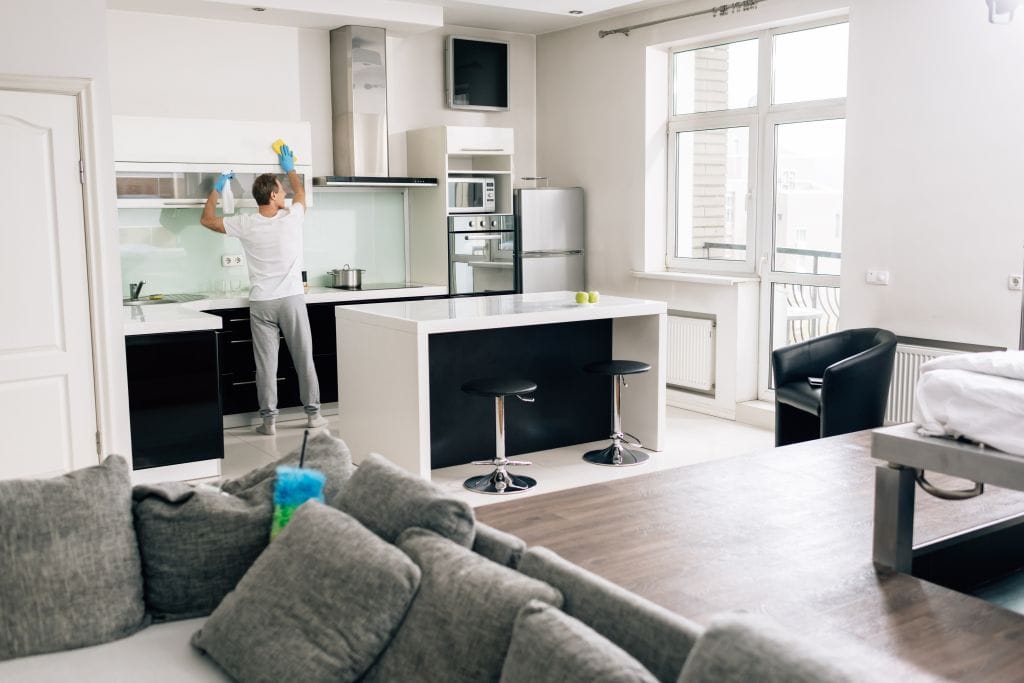
End of tenancy cleaning checklist: what agents actually check
Inventory clerks in London check the same places every time, so your move out cleaning should start there. These are the areas that cost tenants money most often:
- The oven and hob. Burnt-on grease inside the oven, the racks, the glass door and the extractor hood filter.
- Limescale. London’s water is hard, so any move out clean has to deal with scale on taps, shower screens, shower heads and the base of the toilet.
- Carpets. Stains, pet hair and flattened patches. If the inventory says the carpets were professionally cleaned at check-in, expect to be asked for the same. Our carpet steam cleaning is an easy add-on to an end of tenancy clean.
- Kitchen cupboards and drawers, inside and out, including crumbs in the corners.
- The fridge and freezer. Defrosted, wiped, and left with the door slightly open so it doesn’t smell.
- Skirting boards, door frames and light switches. Small, quick, and easy to forget.
- Windows, sills and frames. Including any mould on the seals. With autumn condensation starting, this comes up a lot. We’ve written about cleaning mould and stopping condensation if you’ve got black spots on the frames.
- Bathroom grout and sealant. Grey grout and mould in the silicone are common deduction items.
Moving out with a pet
Now that tenants have the right to ask for a pet, more London renters have one, and more of them will be moving out with one over the next year. Pet hair gets everywhere: in carpets, on skirting boards, inside radiator covers and in the tracks of sliding doors. Landlords will look for it, and smells from pets are a common reason for deductions.
If you’ve had a cat or dog in your London flat, plan for a thorough carpet clean when you move out, and consider upholstery cleaning if the flat came furnished with a sofa or armchairs.
How much does an end of tenancy clean cost in London?
It depends on the size of the property and its condition. At the time of writing, our end of tenancy service starts from:
- £222.95 for a one-bedroom flat
- £318.50 for a two-bedroom flat
- £477.75 for a three-bedroom house
That includes all products and equipment, kitchen and appliances, bathrooms, inside cupboards, skirting boards and inside windows. Extra bathrooms and add-ons like carpet cleaning cost extra. If the agent flags something after the clean, we come back to sort it within 48 hours. For a wider look at what London cleaners charge, see our 2026 cleaning price guide.
Compare that with what a disputed deduction from your tenancy deposit can cost you, plus the weeks of back and forth with the deposit scheme. For most people, the clean pays for itself.
If you’re a landlord or letting agent
Under the Renters’ Rights Act every tenancy is periodic, so you won’t always know months in advance when a tenant is leaving. Two months’ notice is the norm now, so void periods can come up at awkward times. When a tenant moves out, having a London cleaning company you can book at short notice makes the turnaround faster. We work with landlords and estate agents across London on end of tenancy and between-tenancy cleans, and if you let short-term, we also do Airbnb cleaning.
For the full picture on the deposit side, read our guide to getting your full deposit back in London.
Common questions about moving out in 2026
How much notice do I need to give my landlord in 2026?
Under the Renters’ Rights Act, which started on 1 May 2026, tenants in England give two months’ written notice to end a tenancy. Your landlord can agree in writing to accept a shorter notice period.
Did the Renters’ Rights Act change deposit rules?
No. Your landlord still has to protect your tenancy deposit in a government-approved scheme. It’s capped at five weeks’ rent for most tenancies, and the landlord can only deduct for damage, unpaid rent or cleaning beyond fair wear and tear.
Do I have to pay for a professional end of tenancy clean?
No. Under the Tenant Fees Act 2019, a landlord can’t require you to use a professional cleaner. You have to return the property as clean as it was at check-in. If you don’t, the landlord can deduct a reasonable cleaning cost from your deposit.
When should I book my end of tenancy clean?
In London, book move out cleaning four to six weeks ahead in busy months like September and October. Schedule it for after your furniture has gone, ideally a day or two before the check-out inspection.
How long does an end of tenancy clean take?
For a one-bedroom flat, around three and a half hours with two cleaners. A two-bedroom flat takes about five hours. Larger homes or properties in poor condition take longer.
What is the most common reason for deposit deductions in London?
Cleaning is one of the most common, especially dirty ovens, limescale in bathrooms, stained carpets and marks on walls and skirting boards.
Moving out this autumn? Book your move out cleaning in London online early, or send us a message with your move-out date and we’ll help you plan it.


